J
New Member
Join Date: Jan 2022
Posts: 1
01-12-2022, 09:02 AM
#1What is the difference between Smart amps and normal ones? Any significant advantage in the cable and connector losses in my set-up?
Tags: None

What is the difference between Smart amps and normal ones? Any significant advantage in the cable and connector losses in my set-up?
An amp's main purpose is to increase the power of a signal. The amount of amplification provided by an amplifier is measured by its gain. In RF communication systems, RF amplifiers amplify frequencies in the radio frequency range between 20 kHz and 300 GHz.
The difference between a smart amp and a normal one is the "smart function" the smart amplifier has. It consists of an intelligent algorithm and Automatic Gain Controlled (AGC) circuits to maintain the output power and prevent transmit signal saturation.
The gain can be intelligently adapted to the input power level in a wide range and automatically further adjusted to accommodate the cable and connectors loss, irrespective of the length and configuration of the wireless system.
| Smart Amp | Other TDD Amp | |
|---|---|---|
| Transmit Gain | Intelligently self-adjusted | Fixed |
| Input Power Range Requirement | Wide range accepted | Designed for a narrow range |
| Transmit Signal Distortion | Maintained | Varies depending on the input power level |
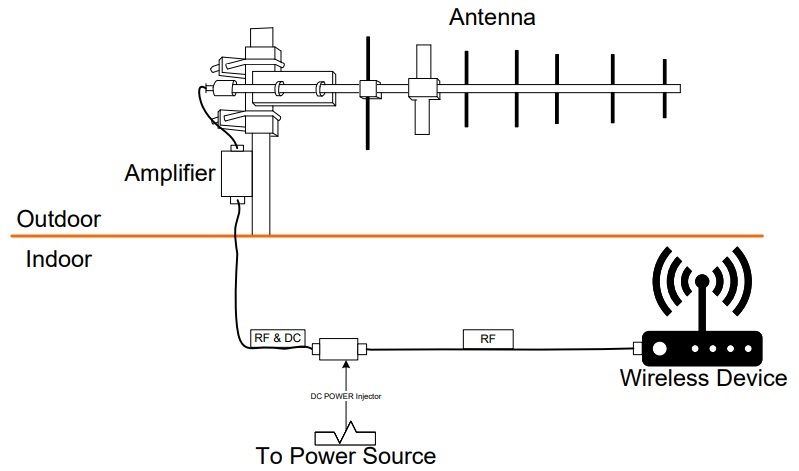
See various amplifiers available for 900 MHz, 2400 MHz, and 5800 MHz frequencies.
Please contact an Rfwel engineering specialist for any wireless application/project that may need an amplifier.